Conduit bending simulation
In Conduit Bending, you mark a stick of 1/2 in. EMT with a tape, set the angle on a hand bender, and bend it. The bent pipe drops into a to-scale drawing, so you see right away if it clears the column or lands on the box. Then you strap it and call the inspector. It builds the skill of using take-up, multipliers, and shrink, and of counting degrees between pull points.
- Stub-ups and take-up
- Offset multipliers and shrink
- 3-point saddles and box offsets
- The 360-degree limit between pull points
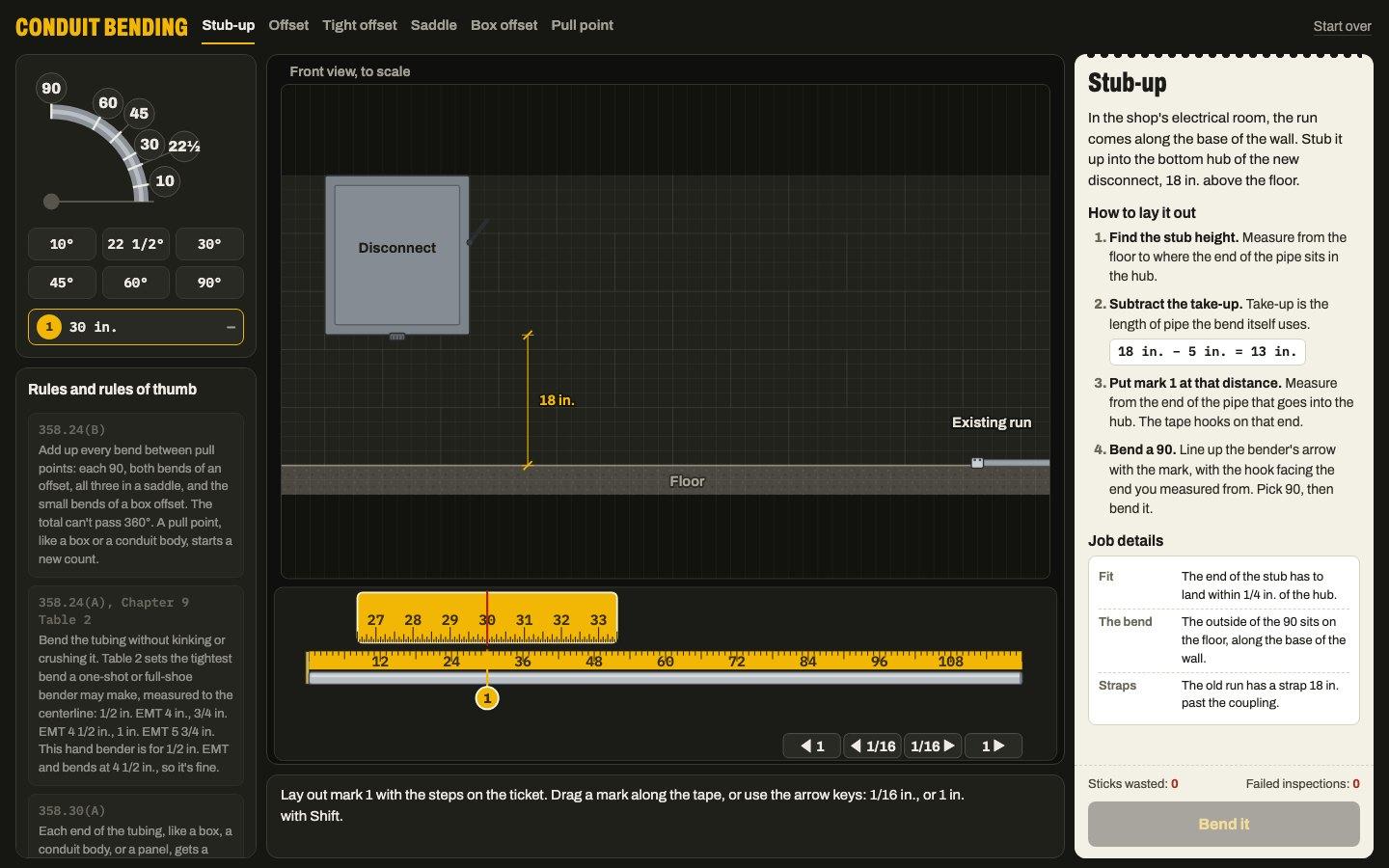
How it works
Each job shows a wall or ceiling drawn to scale and a stick of EMT on the bench. Drag a mark along the stick while the tape reads its distance, and nudge it to 1/16 in. On a phone, drag a mark with your finger or tap the tape to move it, then use the arrow buttons. Pick an angle on the bender's degree marks and press Bend it. The pipe drops into the drawing, and you see where it hits, floats, or lands.
Click the pipe to strap it, then call the inspector. The ticket walks you through each layout step by step with the trade rules of thumb from bender charts. You earn up to three stars: one for passing, one for passing on the first call, and one for not wasting a stick. The simulation runs in a browser on a phone, tablet, or computer, with no sign-up.
The jobs
- 1Stub-up. Stub up from a run along the base of an electrical-room wall into a disconnect hub, using the take-up stamped on the bender.
- 2Offset onto a column. Offset 6 in. onto a column face, and land it at the corner by adding the shrink.
- 3Offset in a tight spot. Choose the one angle that fits 10 in. of room without pushing the run past 360 degrees.
- 43-point saddle. Bend a centered 2 in. 3-point saddle over a copper line and land back on the wall.
- 5Box offset. Line the pipe up with the connector using small bends that don't kink, and count their degrees.
- 6Pull point in a long run. Count a crew-bent run, place a conduit body where the count needs it, and strap it.
NEC 2026 sections it checks
- 358.24(B)
- Add up every bend between pull points. The total can't pass 360 degrees.
- 358.24(A)
- Bends must not damage or flatten the tube, and can't be tighter than the Table 2 radius.
- Chapter 9, Table 2
- Sets the smallest bend radius for each size. For 1/2 in. bent with a one-shot or full-shoe bender, it's 4 in.
- 358.30(A)
- Strap EMT within 3 ft of every box, conduit body, or other end, and at least every 10 ft.
Section numbers only. Read the full text in your code book.
Questions apprentices ask
How many degrees of bends are allowed in a conduit run?
No more than 360 degrees between pull points, such as a box or conduit body. For EMT, that's 358.24(B), and rigid metal conduit and PVC have the same limit (344.24(B), 352.24(B)). Every bend counts, including the small ones in an offset or a box offset.
What is the multiplier and shrink for a 30-degree offset?
The multiplier is 2: space the two marks 2 times the offset depth apart. The shrink is 1/4 in. for every inch of offset depth. Add the shrink to the mark at the obstacle when you measure toward it. A 45-degree offset uses 1.4 and 3/8 in. per inch.
What is take-up on a conduit bender?
Take-up is how much the bend uses up, so you subtract it from the stub height to place your mark. It depends on the bender, and it's stamped on the bender itself. In the Stub-Up job, the 1/2 in. EMT bender is stamped 5 in., so an 18 in. stub gets its mark at 13 in.
What is the minimum bend radius for 1/2 in. EMT?
4 in. to the centerline when you bend it with a one-shot or full-shoe bender, from Chapter 9, Table 2 (358.24(A)). A standard hand bender for 1/2 in. EMT already meets that. The real risk is kinking the tube by putting bends too close together.
How this simulation was checked
Every rule the inspector applies was checked against the 2026 NEC text in a code review, and the game was play-tested for ease of use. It is a study aid. It doesn’t replace the code book, your instructor, or your local inspector.
See something wrong? Tell us and we will check it against the code.
I’m building these with instructors. What would you change? Tell Matt what is wrong or missing.
Teach it in one class
This simulation is part of a free lesson that plays in your browser, with a class plan and quiz questions: Conduit bending (NEC 2026 Articles 344, 352, and 358).
Teaching a class?
Build a cited slide deck and quiz on any part of the 2026 NEC, in your own order, and assign this simulation as practice. Free for instructors during the pilot.
Check your work with a calculator
- Offset bendDistance between bends and shrink for any offset.
- 90° stub-upWhere to mark the EMT for a stub at the height you need.
- 3-point saddleCenter and outer marks to cross a pipe or obstruction.
- Conduit bending cheat sheetMultipliers, take-up, shrink, and saddle marks in one table.
More simulations
- Secure and SupportMeasure the run and drive staples and straps where the NEC 2026 says, using as few as the inspector will pass.
- Burial DepthDig the trench, read Table 300.7(A), and bury each run at the shallowest legal depth for its wiring method and location.
- Rough-InSet boxes on studs, pull cable through the wall, land each wire on its screw, and flip the breaker.