Rough-in wiring simulation
In Rough-In, you wire a room from the panel out: set boxes on studs, pull cable, land each wire, and turn on the breaker. You watch current go out on the hot and come back on the neutral, and then an inspector checks your work against the 2026 NEC. It builds the habits behind polarity, grounding, and matching the breaker to the wire.
- Hot, neutral, and ground
- Pigtails and grounding
- Overloads and faults
- Matching the breaker to the wire
How it works
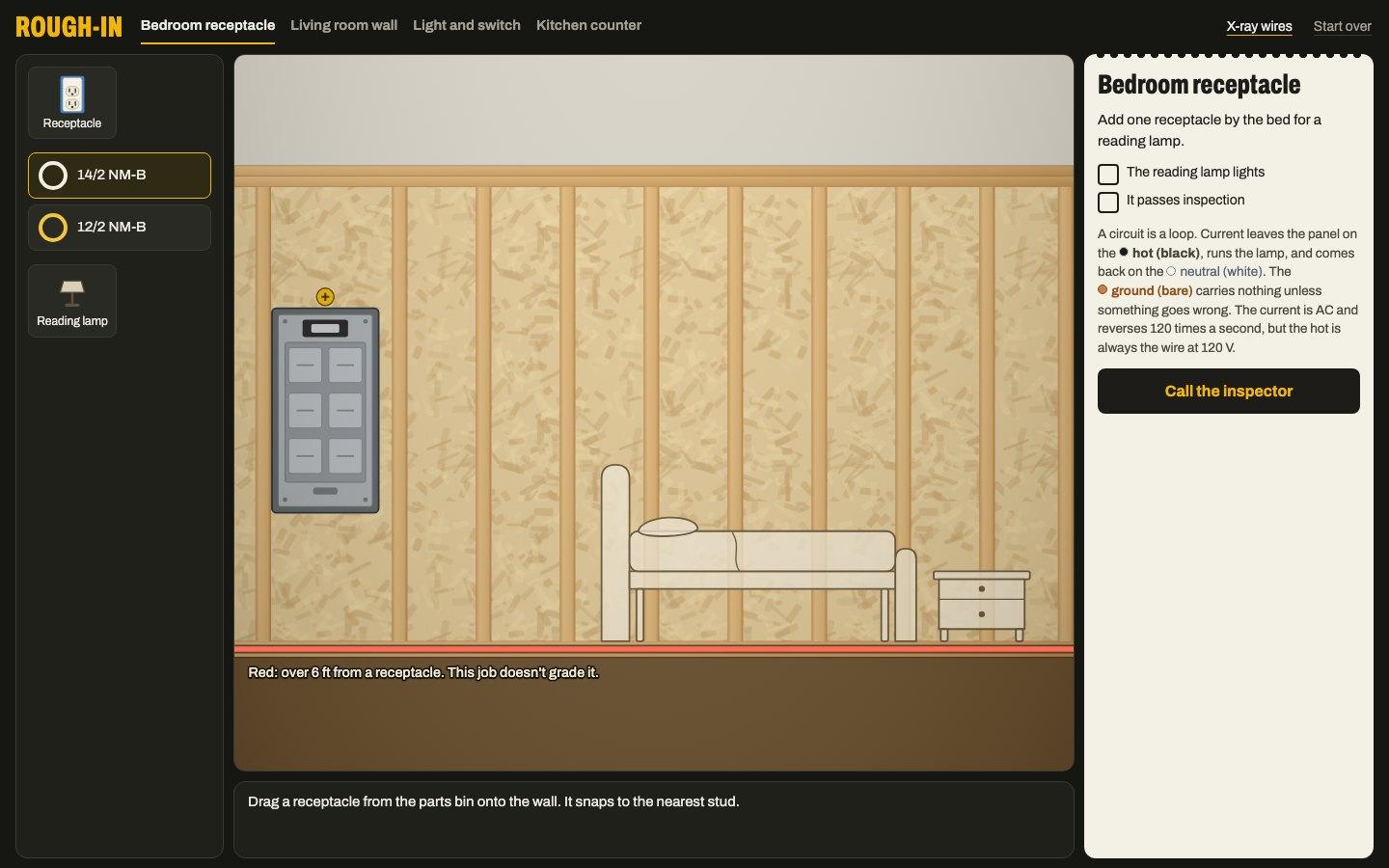
Each job starts with a work order from a customer. You drag boxes from the parts bin onto the wall, where they snap to a stud. Then you drag cable from the panel through the studs to each box. On a phone, tap a part, then tap the wall where it goes. To run a cable, tap the yellow + and then a box.
Click a box to open it and land each wire: the ground first, then the hot on brass and the neutral on silver. On a phone, tap a box to see its name, tap it again to open it, then tap a wire and then its screw. In the panel, add a breaker that matches the wire, land the hot, neutral, and ground, and flip the breaker on. You watch current flow, plug in the loads, and call the inspector.
You earn up to three stars: one when the job works, one when it passes inspection, and one for passing on the first inspection. The simulation runs in a browser on a phone, tablet, or computer, with no sign-up.
The jobs
- 1Bedroom receptacle. Add one bedroom receptacle and see current leave on the hot and return on the neutral.
- 2Living room wall. Put several receptacles on one wall, keep every spot within 6 ft of one, and see how loads add up on a breaker.
- 3Light and switch. Wire a ceiling light on a switch that breaks only the hot, with the neutral brought into the switch box.
- 4Kitchen counter. Feed counter receptacles from two 20 A circuits with GFCI protection, and bond every metal box so a fault trips the breaker.
NEC 2026 sections it checks
- 200.11
- Keep polarity: the hot lands on the brass screw, the neutral on the silver screw.
- 250.148
- Splice every ground in a box together, and give a metal box its own ground connection.
- 406.30
- A switch breaks the hot, never the neutral, and a lighting switch box gets the neutral.
- 250.24(B)
- Neutral and ground meet only at the main panel, never out in a box.
- 240.4(D)
- 14 AWG copper gets a 15 A breaker at most, and 12 AWG copper gets 20 A.
- 210.23(B)(1)
- One plug-in appliance can use no more than 80% of its circuit.
- 210.52(B)(3)
- A kitchen counter needs at least two 20 A small-appliance circuits.
- 210.8(A)
- Kitchen receptacles in a home need GFCI protection.
Section numbers only. Read the full text in your code book.
2023 to 2026: our list has 2 changes in 210.52. See the changes
Questions apprentices ask
Which screw does the black wire go on?
The hot (black) goes on the brass screw, and the neutral (white) goes on the silver screw (200.11). If you swap them, the lamp still lights, but the lamp shell and the long slot become hot. Rough-In flags this as reversed polarity.
Why does a switch box need a neutral?
Under 406.30(C), a switch box for room lighting needs the neutral of the circuit it switches, with some exceptions. That lets you add a smart switch or sensor later without new cable. The switch itself still breaks only the hot, never the neutral (406.30(B)).
What size breaker goes on 14 AWG and 12 AWG wire?
Under 240.4(D), 14 AWG copper gets a 15 A breaker at most, and 12 AWG copper gets 20 A. A bigger breaker lets the wire overheat before the breaker trips. In Rough-In, a 20 A circuit uses 12/2 cable on a 20 A breaker.
Why do you bond a metal box to the ground?
A metal box needs its own ground connection, such as a pigtail from the ground splice to the box's green screw (250.148(C)). If a hot wire touches the box, the fault trips the breaker instead of shocking someone. The Kitchen counter job fault-tests every metal box.
How this simulation was checked
Every rule the inspector applies was checked against the 2026 NEC text in a code review, and the game was play-tested for ease of use. It is a study aid. It doesn’t replace the code book, your instructor, or your local inspector.
See something wrong? Tell us and we will check it against the code.
I’m building these with instructors. What would you change? Tell Matt what is wrong or missing.
Teach it in one class
This simulation is part of a free lesson that plays in your browser, with a class plan and quiz questions: Rough-in: branch circuits and receptacle layout (NEC 2026 210.52, 210.11, 210.23).
Teaching a class?
Build a cited slide deck and quiz on any part of the 2026 NEC, in your own order, and assign this simulation as practice. Free for instructors during the pilot.
Check your work with a calculator
- Box fillMinimum box volume from conductors, devices, clamps, and grounds.
- Ground wire (EGC) sizeMinimum equipment grounding conductor from the breaker or fuse size.
More simulations
- Three-Way LabWire 3-way and 4-way switches so the light works from every door, and test every switch combination.
- SpacingPlace receptacles on a floor plan so no spot on the wall is too far from one. Use as few as you can.
- Protection MapProtect a whole house with GFCI and AFCI devices on a budget, and pass the inspector.