Loose connection
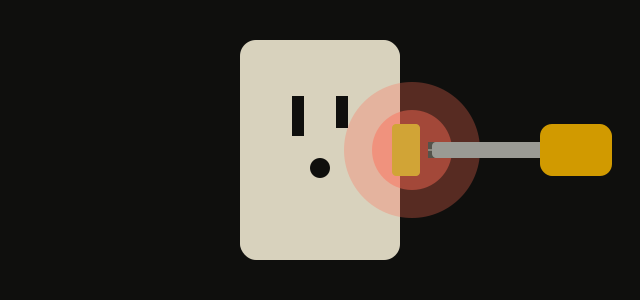
A space heater runs through one receptacle. You loosen a single terminal screw and watch heat build at that spot while the breaker sees normal current.
Open the visualFree, no sign-up. Works on a phone, tablet, computer, or projector.
What to try
- 1Start on Torqued and note the screw temperature.
- 2Set Screw to Loose. The breaker goes off and is tested dead first. Set Breaker to On and press Faster. The heat at the screw climbs while the breaker sees normal current.
- 3Pick Unplugged. With no current, the screw makes no heat, but the wires are still live.
NEC 2026 sections it covers
- 110.14(D)
- Screws are torqued to the maker's value with an approved means.
- 110.14(A)
- One wire per screw unless it is marked for two.
- 110.14(B)
- Splices need an identified connector.
- 110.14(C)
- Terminals are rated 60 or 75°C.
- 334.112
- NM insulation is rated 90°C.
- 334.80(A)
- NM ampacity uses the 60°C column.
- Table 210.21(B)(2)
- A 15 A receptacle may feed only 12 A, so this circuit uses 20 A receptacles.
- 300.15(B)
- A multiwire circuit's neutral must be pigtailed.
- 406.10
- Push-in holes are allowed only on 15 A circuits with 14 AWG solid copper.
- 210.12(B)
- Most rooms in a home need AFCI protection. An AFCI does not sense heat.
Section numbers only. Read the full text in your code book. Temperatures and times in the visual are teaching models.
See something wrong? Tell us and we will check it against the code.
Practice it and teach it
- Rough-In simulationSet boxes on studs, pull cable through the wall, land each wire on its screw, and flip the breaker.
- Rough-in lessonRough-in: branch circuits and receptacle layout (NEC 2026 210.52, 210.11, 210.23)
More visuals
- Shared neutralTwo hots share one white wire. Load each side, then pull the white loose and watch the voltages swing.
- Crowded conduitAdd circuits to one pipe and watch the wires heat each other until each is allowed less current.
- Neutral and ground in a subpanelIn a subpanel, the neutral and ground stay apart. Leave the bonding screw in and normal current rides on the ground wire and the metal can.