GFCI and AFCI protection simulation
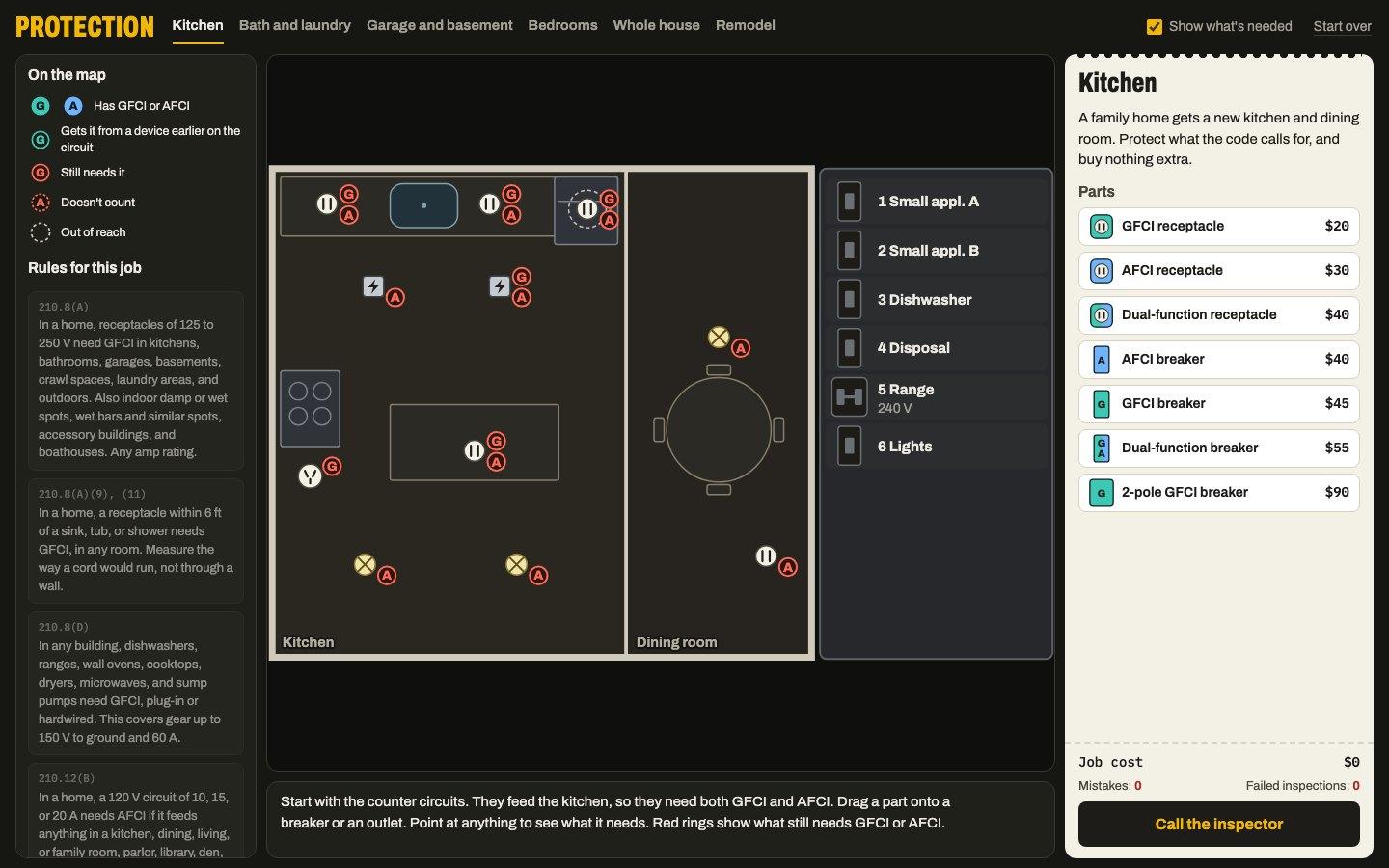
In Protection Map, you protect every circuit in a house with GFCI and AFCI devices at the lowest legal cost. The inspector checks each outlet against 210.8 and each circuit against 210.12. It builds the skill of reading what a circuit feeds and choosing between a breaker and a receptacle.
- Where GFCI is required
- Where AFCI is required
- Breaker or receptacle: which to use
- What a GFCI protects downstream
How it works
Each job shows a floor plan, the panel, and every circuit. Point at an outlet or breaker to see what it feeds and where it sits on the circuit. Drag GFCI or AFCI receptacles, or GFCI, AFCI, or dual-function breakers, onto breakers or outlets. A GFCI receptacle protects everything after it on the circuit. On a phone, tap a part to pick it up, tap a breaker or outlet to see what it needs, then tap it again to put the part there.
Call the inspector to check every circuit. You earn up to three stars: one for passing, one for passing on the first call with no mistakes, and one for the lowest legal cost. Some jobs also set a budget. The simulation runs in a browser on a phone, tablet, or computer, with no sign-up.
The jobs
- 1Kitchen. Protect the kitchen and dining circuits, and see when one dual-function breaker costs less than two devices.
- 2Bath and laundry. Learn that bathrooms need GFCI but no AFCI, laundry areas need both, and some receptacles are exempt.
- 3Garage and basement. Put each GFCI where you can reach it, and protect crawl space lights and hardwired outdoor gear.
- 4Bedrooms. Use AFCI breakers, and see when an AFCI receptacle at the first outlet counts on a metal run.
- 5Whole house. Protect a small house on a fixed budget with the cheapest legal part on each circuit.
- 6Remodel. Clear an inspector's red tags by reusing parts already in the house, including on an old circuit that was extended.
NEC 2026 sections it checks
- 210.8(A)
- In a home, receptacles in kitchens, bathrooms, garages, basements, crawl spaces, laundry areas, and outdoors need GFCI.
- 210.8(C)
- Crawl space lights need GFCI.
- 210.8(D)
- Dishwashers, ranges, wall ovens, cooktops, dryers, microwaves, and sump pumps need GFCI, plug-in or hardwired.
- 210.8(F)
- Outdoor outlets at a home need GFCI, hardwired ones too. Outdoor lights don't.
- 210.12(B)
- In a home, 120 V circuits up to 20 A that feed kitchens, bedrooms, living areas, hallways, and laundry areas need AFCI.
- 210.12(A)(1)
- An AFCI breaker protects the whole circuit.
- 210.12(A)(5)
- An AFCI receptacle at the first outlet counts when the run from the panel to it is metal.
- 210.12(E)
- Extending an old circuit in those rooms brings in the AFCI requirement.
Section numbers only. Read the full text in your code book.
2023 to 2026: our list has 5 changes in 210.8. See the changes
Questions apprentices ask
Does a kitchen need GFCI and AFCI?
Yes, in a home. Every kitchen receptacle needs GFCI (210.8(A)), and every 120 V, 15 or 20 A kitchen circuit needs AFCI (210.12(B)). A 240 V range skips AFCI but still needs GFCI (210.8(D)). One dual-function breaker gives a circuit both kinds of protection.
Does a bathroom need AFCI?
No. In a home, bathroom receptacles need GFCI (210.8(A)), but bathrooms aren't on the AFCI list in 210.12(B). Laundry areas are on both lists, so they need GFCI and AFCI.
Can an AFCI receptacle take the place of an AFCI breaker?
Sometimes. An AFCI breaker covers the whole circuit (210.12(A)(1)). An AFCI receptacle at the first outlet counts when the run from the panel to it is metal, such as MC cable with metal boxes (210.12(A)(5)), or encased in 2 in. of concrete (210.12(A)(6)). A few listed breaker-and-receptacle pairs also qualify (210.12(A)(2) to (4)). In this game, an NM circuit needs the AFCI breaker.
Where should a GFCI receptacle go on a circuit?
Put it ahead of the outlets it protects, and wire the rest of the circuit to its LOAD terminals so it protects everything after it. The GFCI device itself must be readily accessible: no ladder, no tools, and nothing to move out of the way (210.8, Article 100).
How this simulation was checked
Every rule the inspector applies was checked against the 2026 NEC text in a code review, and the game was play-tested for ease of use. It is a study aid. It doesn’t replace the code book, your instructor, or your local inspector.
See something wrong? Tell us and we will check it against the code.
I’m building these with instructors. What would you change? Tell Matt what is wrong or missing.
Teach it in one class
This simulation is part of a free lesson that plays in your browser, with a class plan and quiz questions: GFCI and AFCI protection (NEC 2026 210.8, 210.12).
See how it works
These interactive pictures show what happens inside the wiring.
Teaching a class?
Build a cited slide deck and quiz on any part of the 2026 NEC, in your own order, and assign this simulation as practice. Free for instructors during the pilot.
More simulations
- SpacingPlace receptacles on a floor plan so no spot on the wall is too far from one. Use as few as you can.
- Working SpaceDrag a panel along the wall, move what's in the way, and keep a clear, code-sized working space in front of it.
- Rough-InSet boxes on studs, pull cable through the wall, land each wire on its screw, and flip the breaker.