Three-way switch wiring simulation
In Three-Way Lab, you wire single-pole, 3-way, and 4-way switches so one light works from every door. A chart tests every switch combination, and the inspector checks that only the hot gets switched under 406.30. It builds the skills you need to land travelers, re-mark a white wire, and fix a callback.
- Travelers and the common
- When a white wire gets re-marked
- Adding 4-way switches
- Fixing a callback
How it works
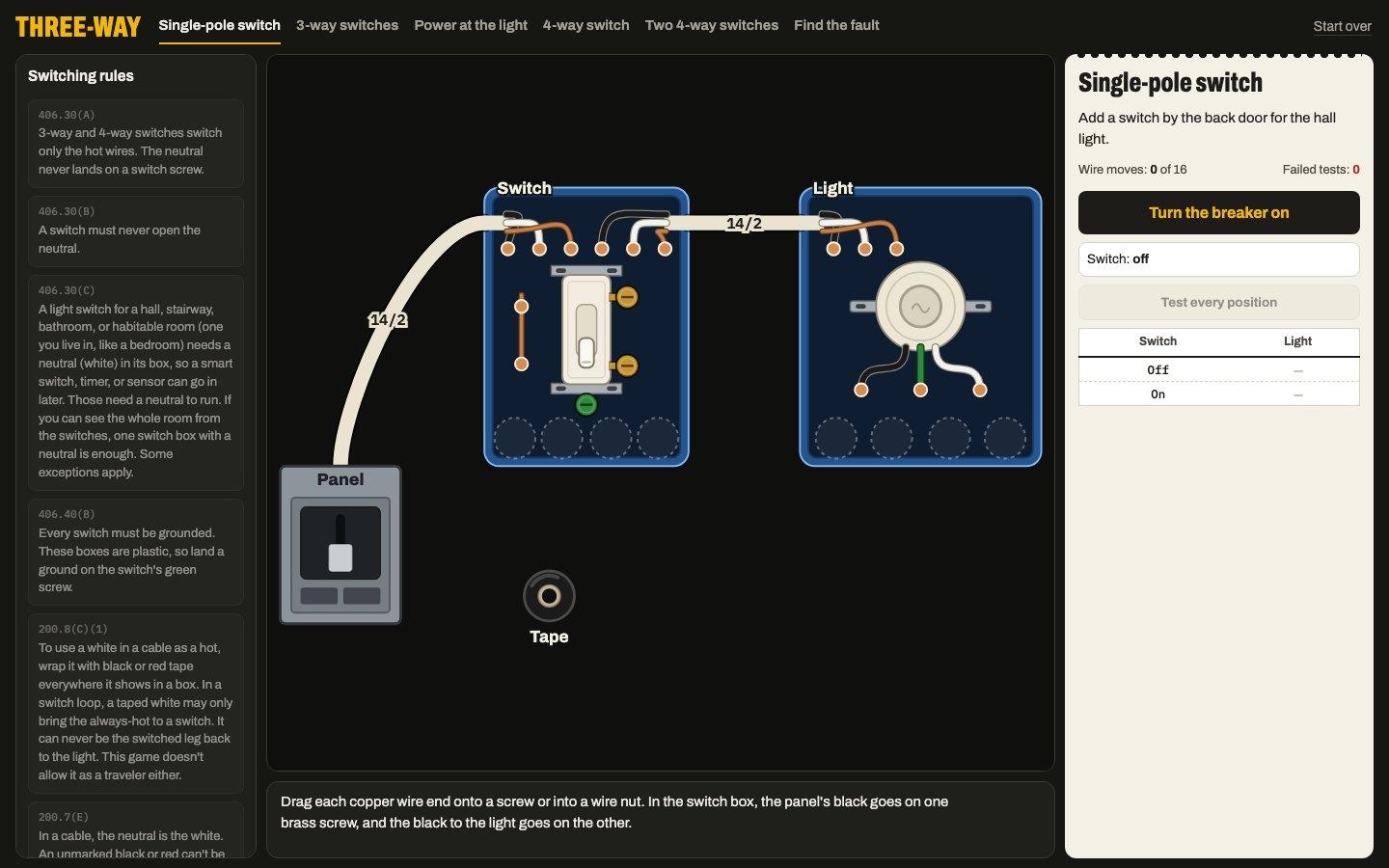
Each job gives you the switch boxes, the light, and the cable already run. Drag each wire end onto a screw, splice the whites and grounds, and drop tape on any white you use as a hot. On a phone, tap a wire end, then tap the screw or wire nut where it goes. You can also drag wires with your finger.
Turn on the breaker, then flip each switch. A chart fills in one row for every switch combination, and every flip has to change the light. A wiring mistake can trip the breaker, and the ticket lists every problem with its section number.
You earn up to three stars: one for a working job, one for no failed tests, and one for finishing at or under par in wire moves. The simulation runs in a browser on a phone, tablet, or computer, with no sign-up.
The jobs
- 1Single-pole switch. Wire a single-pole switch that breaks only the hot, with the whites spliced through the switch box.
- 23-way switches. Wire two 3-ways: the dark COM screws take power and the light, and the brass screws take the travelers.
- 3Power at the light. Bring power in at the light, and use a taped white to carry the always-hot to a switch.
- 44-way switch. Add a 4-way between two 3-ways so the light works from three doors.
- 5Two 4-way switches. Wire two 4-ways in a row, with the 3-ways at the ends of the run.
- 6Find the fault. Find the one wire that makes a light work only sometimes, and fix it in as few moves as you can.
NEC 2026 sections it checks
- 406.30(A)
- 3-way and 4-way switches switch only the hot wires.
- 406.30(B)
- A switch never opens the neutral.
- 406.30(C)
- Bring a neutral into lighting switch boxes so a smart switch can go in later. Some exceptions apply.
- 200.8(C)(1)
- Tape a white you use as a hot. In a switch loop, it may only bring the always-hot to the switch.
- 406.40(B)
- Ground every switch.
- 250.148(A)
- Join all the grounds in a box.
- 200.11
- Keep polarity at the fixture: neutral to its white lead, hot to its black lead.
- 110.14(A)
- One wire per screw unless the terminal is marked for more.
Section numbers only. Read the full text in your code book.
Questions apprentices ask
Why does a 3-way switch need a 3-wire cable?
Two 3-way switches connect through two travelers, the black and red in a 14/3 cable. The white in that cable carries the neutral, so each switch box can have one (406.30(C)). The bare wire grounds each switch (406.40(B)).
Which screw is the common on a 3-way switch?
The dark COM screw takes the power coming in at one switch and the wire going on to the light at the other. The two brass screws take the travelers, and the neutral never lands on a switch screw (406.30(A)). A traveler on COM is the classic callback: the light works only in some switch positions.
Can a white wire be a hot in a switch loop?
Yes, if you re-mark it with black or red tape where it shows in a box (200.8(C)(1)). In a switch loop, a taped white may only bring the always-hot to a switch. It can never be the switched wire back to the light. Three-Way Lab doesn't allow it as a traveler either.
How do you wire a 4-way switch?
A 4-way goes between the two 3-ways. The travelers from one 3-way land on one pair of screws, and the travelers to the other 3-way land on the second pair. Add as many 4-ways as you need, and keep the 3-ways at the ends, since every switch breaks only the hot (406.30(A)). Real switches vary, so check the label.
How this simulation was checked
Every rule the inspector applies was checked against the 2026 NEC text in a code review, and the game was play-tested for ease of use. It is a study aid. It doesn’t replace the code book, your instructor, or your local inspector.
See something wrong? Tell us and we will check it against the code.
I’m building these with instructors. What would you change? Tell Matt what is wrong or missing.
Teach it in one class
This simulation is part of a free lesson that plays in your browser, with a class plan and quiz questions: Three-way and four-way switches (NEC 2026 406.30).
Teaching a class?
Build a cited slide deck and quiz on any part of the 2026 NEC, in your own order, and assign this simulation as practice. Free for instructors during the pilot.
Check your work with a calculator
More simulations
- Rough-InSet boxes on studs, pull cable through the wall, land each wire on its screw, and flip the breaker.
- SpacingPlace receptacles on a floor plan so no spot on the wall is too far from one. Use as few as you can.
- Protection MapProtect a whole house with GFCI and AFCI devices on a budget, and pass the inspector.