Switch the hot
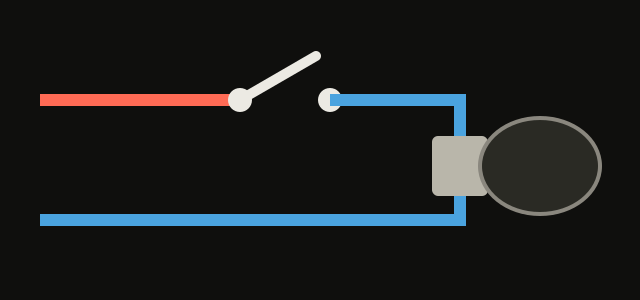
A light switch turns a lamp off by opening one of its two wires. Each wire glows by its voltage to ground, so you see which parts of the socket stay live when the light is off.
Open the visualFree, no sign-up. Works on a phone, tablet, computer, or projector.
What to try
- 1On Wired right, set Switch to Off and tap the socket to test it.
- 2Pick Switch on the neutral and set Switch to Off. The lamp goes dark, but the hot still reaches the socket.
- 3Pick Swapped at the light, set Bulb to Out, and tap the threaded shell to test it.
NEC 2026 sections it covers
- 406.30(B)
- A switch goes on the hot, never the neutral.
- 410.90
- The white wire goes to the threaded shell of the socket.
- 200.11
- Swapping the hot and neutral reverses polarity.
- 240.4(D)
- 14 AWG copper gets a 15 A breaker at most.
- 250.104(A)(1)
- A metal water pipe is bonded at the service.
- 210.12(B)
- Many rooms in a home also need AFCI protection.
Section numbers only. Read the full text in your code book. Temperatures and times in the visual are teaching models.
See something wrong? Tell us and we will check it against the code.
Practice it and teach it
- Three-Way Lab simulationWire 3-way and 4-way switches so the light works from every door, and test every switch combination.
- Three-way switches lessonThree-way and four-way switches (NEC 2026 406.30)
More visuals
- 120 and 240 voltsOne coil on the pole makes two legs that mirror each other. Put a meter across any two wires.
- From the pole to the panelThe transformer on the pole sends two hots and a neutral to the house. Break the neutral and watch the voltages split.
- Three-phase powerA three-phase panel has three hots, each a third of a cycle apart. Two hots read 208 volts, not 240.