From the pole to the panel
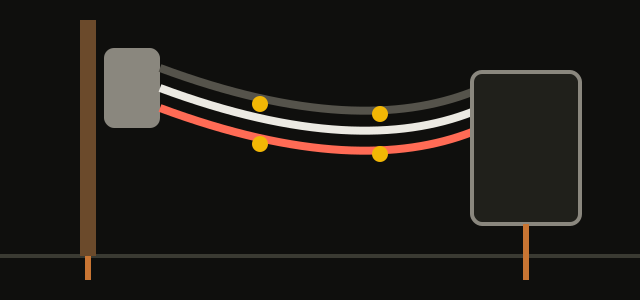
The transformer on the pole sends two hots and a neutral to the house. The neutral is tied to the earth at the pole and again at the house panel. You change the load on each leg and break the utility neutral to see what happens.
Open the visualFree, no sign-up. Works on a phone, tablet, computer, or projector.
What to try
- 1Start on Same load on each leg. The current goes out one hot and back on the other, so the neutral carries 0 amps.
- 2Pick More load on one leg. The neutral carries the difference between the two legs.
- 3Pick Utility neutral broken. Heater A gets less than 120 volts, heater B gets more, and the water pipe carries current back to the pole.
NEC 2026 sections it covers
- 250.24(A)
- At the service, the wire to the ground rod and water pipe connects to the neutral.
- 250.24(C)
- The neutral and the panel are tied together in the service disconnect.
- 250.142(A)
- The meter can may be tied to the neutral ahead of the service disconnect.
- 250.24(B)
- The neutral is not bonded again past the service.
- 250.52(A)(1)
- A metal underground water pipe is a grounding electrode.
- 250.53(D)(2)
- A water pipe electrode needs a second electrode, here a ground rod.
- 250.50
- The electrodes at a building are bonded together.
- 210.20(A)
- A continuous load gets a breaker of at least 125% of its amps.
- 240.4(D)
- 12 AWG copper gets a 20 A breaker at most.
- 230.54(C)
- The weatherhead sits above the point where the drop is attached.
- 230.54(F)
- The drop is spliced in drip loops so water runs off.
Section numbers only. Read the full text in your code book. Temperatures and times in the visual are teaching models.
See something wrong? Tell us and we will check it against the code.
Practice it and teach it
- Ground Rods simulationDrive rods, clamp the water pipe and footing, size the GEC, and fix a failed inspection.
- Grounding and bonding lessonGrounding vs. bonding (NEC 2026 Article 250)
More visuals
- 120 and 240 voltsOne coil on the pole makes two legs that mirror each other. Put a meter across any two wires.
- Switch the hotWires are colored by voltage. See why a light can be off and still live.
- Three-phase powerA three-phase panel has three hots, each a third of a cycle apart. Two hots read 208 volts, not 240.