Ground rod simulation
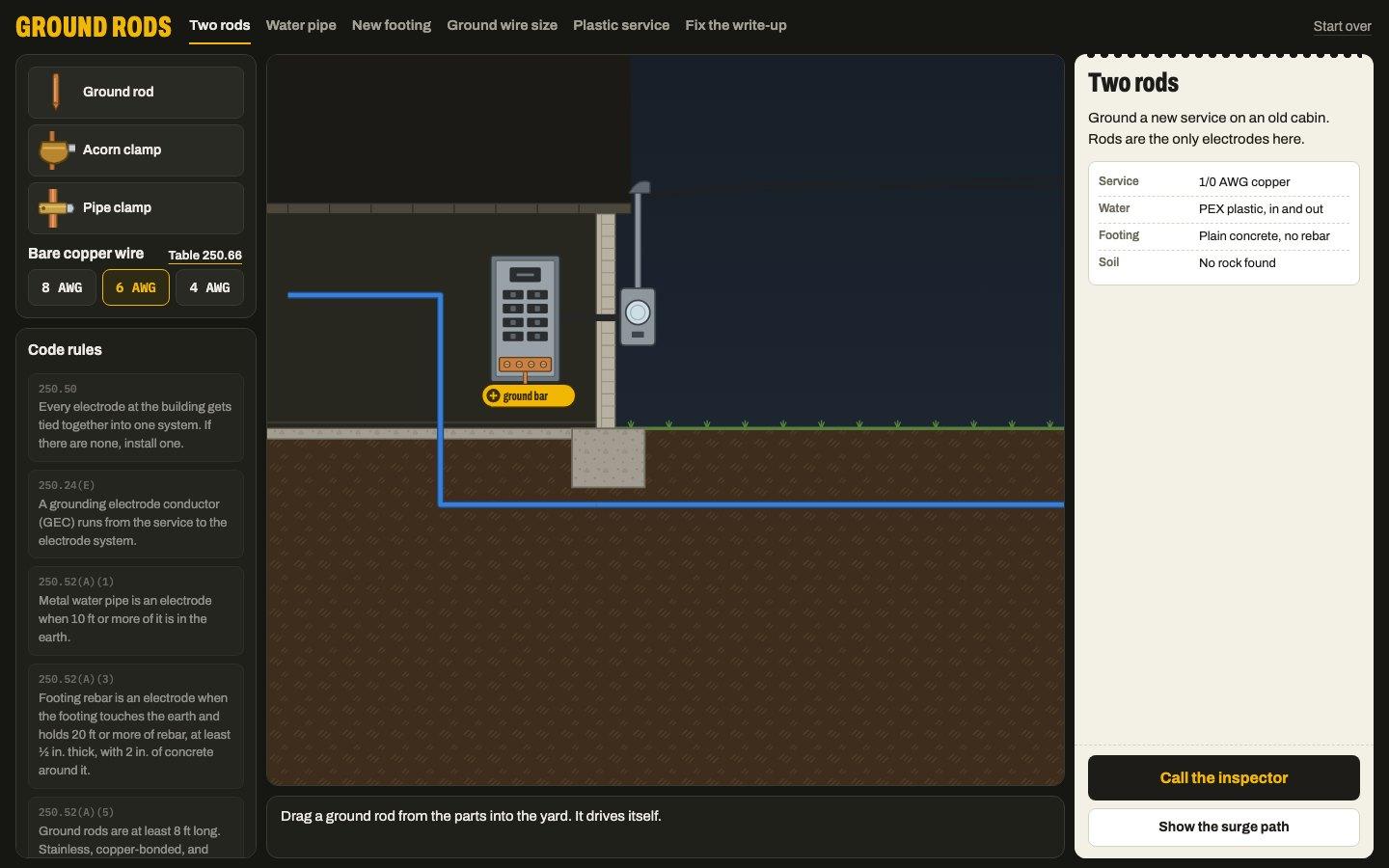
In Ground Rods, you build a grounding electrode system: drive rods, clamp the water pipe and footing rebar, and run the grounding electrode conductor (GEC) from the service. The inspector checks your work against 250.50, 250.53, and 250.66. It builds the skill of bonding every electrode on site and sizing each wire without wasting copper.
- The grounding electrode system
- Rod spacing and depth
- GEC and bonding jumper sizes
- Water pipe and footing electrodes
How it works
Each job shows a house, its service, and the yard. Drag ground rods from the bin into the yard, and drop clamps on rod tops, the rebar stub-up, or the water pipe. Then pick a wire size on the reel and drag from the ground bar to each clamp. On a phone, tap a part, then tap the drawing where it goes. To run a wire, tap the ground bar, then tap a clamp.
Call the inspector to check the system. You earn up to three stars: one for passing, one for passing on the first call, and one for no oversized wire and no extra rods. The simulation runs in a browser on a phone, tablet, or computer, with no sign-up.
The jobs
- 1Two rods. Ground a cabin with rods only, and learn that one rod needs a partner at least 6 ft away.
- 2Water pipe. Clamp the water pipe in its first 5 ft, keep the meter out of the path, and add rods to back up the pipe.
- 3New footing. Tie in every electrode on a new house, footing rebar included, and size each wire to what it reaches.
- 4GEC size. Size the GEC to the electrodes from Table 250.66 for a big service upgrade without wasting copper.
- 5Plastic service. See why less than 10 ft of buried metal pipe isn't an electrode, and bond the copper pipe inside anyway.
- 6Fix the write-up. Read a failed inspection, fix every item, and recheck the whole system.
NEC 2026 sections it checks
- 250.50
- Tie every electrode at the building into one system.
- 250.52(A)
- Metal water pipe, footing rebar, and ground rods can serve as electrodes when they meet size rules.
- 250.53(A)(2)
- One rod needs a partner electrode. A water pipe doesn't count as the partner, and only a test of 25 ohms or less lets you skip it.
- 250.53(A)(3)
- Keep rods at least 6 ft apart.
- 250.53(A)(4)
- Drive each rod so 8 ft is in the soil, at up to 45 degrees if you hit rock.
- 250.53(D)
- A water pipe electrode always gets a second electrode, and the bond can't depend on the meter.
- 250.66
- Size the GEC from the largest hot service wire. A wire to only rods never needs more than 6 AWG copper.
- 250.104(A)(1)
- Bond the metal water pipe inside, sized from Table 250.102(C)(1).
Section numbers only. Read the full text in your code book.
2023 to 2026: our list has 12 changes in Article 250. See the changes
Questions apprentices ask
How far apart do ground rods need to be?
Two or more rods must be at least 6 ft apart (250.53(A)(3)). Drive each rod so 8 ft is in the soil, and if you hit rock, you can drive it at up to 45 degrees (250.53(A)(4)). When you measure spacing for an angled rod, its tip counts.
Do you need two ground rods?
A single rod needs a partner electrode, such as a second rod or footing rebar (250.53(A)(2)). A water pipe doesn't count as that partner, even when the rod was added for the pipe (250.53(D)(2)). Only a test showing 25 ohms or less lets you skip the partner.
What size GEC do you need?
Table 250.66 sizes the GEC from the largest hot service wire. For example, 350 kcmil aluminum service wire needs a 2 AWG copper GEC. A wire that reaches only rods never needs to be bigger than 6 AWG copper (250.66(A)), and one that reaches only footing rebar never needs to be bigger than 4 AWG copper (250.66(B)).
Is a metal water pipe a grounding electrode?
It is when 10 ft or more of metal pipe is in the earth (250.52(A)(1)). Clamp it within its first 5 ft inside the building (250.68(C)(1)), and keep the meter out of the path (250.53(D)(1)). It always needs a second electrode added, such as ground rods (250.53(D)(2)).
How this simulation was checked
Every rule the inspector applies was checked against the 2026 NEC text in a code review, and the game was play-tested for ease of use. It is a study aid. It doesn’t replace the code book, your instructor, or your local inspector.
See something wrong? Tell us and we will check it against the code.
I’m building these with instructors. What would you change? Tell Matt what is wrong or missing.
Teach it in one class
This simulation is part of a free lesson that plays in your browser, with a class plan and quiz questions: Grounding vs. bonding (NEC 2026 Article 250).
See how it works
These interactive pictures show what happens inside the wiring.
Teaching a class?
Build a cited slide deck and quiz on any part of the 2026 NEC, in your own order, and assign this simulation as practice. Free for instructors during the pilot.
Check your work with a calculator
More simulations
- Rough-InSet boxes on studs, pull cable through the wall, land each wire on its screw, and flip the breaker.
- Three-Way LabWire 3-way and 4-way switches so the light works from every door, and test every switch combination.
- SpacingPlace receptacles on a floor plan so no spot on the wall is too far from one. Use as few as you can.