Grounding and bonding
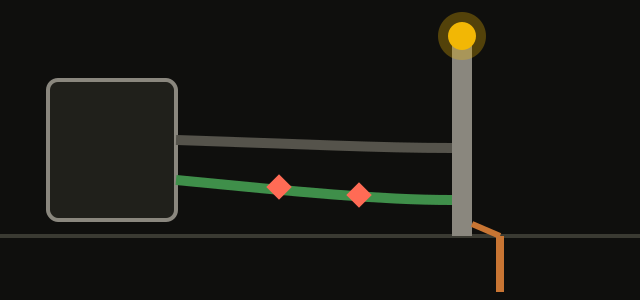
A ground wire runs from a metal light pole back to the panel, where a bonding jumper ties it to the neutral. That path lets fault current get back to the transformer, so the breaker trips. You take the ground wire away, leave only a ground rod, and see what the pole does.
Open the visualFree, no sign-up. Works on a phone, tablet, computer, or projector.
What to try
- 1On Ground wire in place, set Fault to Hot touches pole. Hundreds of amps rush back on the ground wire, and the breaker trips at once.
- 2Pick Ground rod only and set Fault to Hot touches pole. The earth lets only a few amps back, so the 20 amp breaker stays on and the pole stays live.
- 3Keep the fault on and set Hand to Touching. Now the current goes through the person.
NEC 2026 sections it covers
- 250.4(A)(5)
- Fault current needs a low-resistance path back to the source, and the earth is not that path.
- 250.24(C)
- The main bonding jumper ties the neutral to the ground wires at the service.
- 250.54
- A rod at the pole is allowed as an extra, never in place of the ground wire.
- 250.4(A)(1)
- The ground rod limits voltage from lightning and surges. It does not trip a breaker.
- 250.53(A)(2)
- One rod of 25 ohms or less to earth needs no second electrode.
- 240.4(D)
- 12 AWG copper gets a 20 A breaker at most.
- Table 250.122
- A 20 A circuit gets a 12 AWG copper ground wire.
- 210.8(F)
- Outdoor outlets at a home need GFCI protection, but yard lighting is an exception.
- 230.54(C)
- The weatherhead sits above the point where the drop is attached.
- 230.54(F)
- The drop is spliced in drip loops so water runs off.
Section numbers only. Read the full text in your code book. Temperatures and times in the visual are teaching models.
See something wrong? Tell us and we will check it against the code.
Practice it and teach it
- Ground Rods simulationDrive rods, clamp the water pipe and footing, size the GEC, and fix a failed inspection.
- Grounding and bonding lessonGrounding vs. bonding (NEC 2026 Article 250)
More visuals
- Breaker and wirePlug in loads and watch the wire heat up when the breaker is too big for it.
- What a GFCI sensesCurrent goes out and comes back. See what happens when a little goes missing through a person.
- What an AFCI sensesA crushed cord arcs. Watch the shape of the current change, and the breaker count it.