Breaker and wire
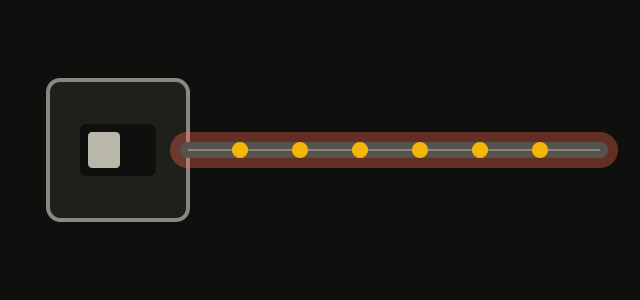
A breaker protects the wire behind the wall. You plug in loads and watch the cable heat up, and see what happens when the breaker is too big for the wire.
Open the visualFree, no sign-up. Works on a phone, tablet, computer, or projector.
What to try
- 1On Light load, the lamp and the vacuum keep the 14 AWG wire cool.
- 2Pick Too much load. The heater and hair dryer together trip the 15 A breaker.
- 3Pick Breaker too big and press Faster. The 30 A breaker holds while the 14 AWG wire heats past 90°C.
NEC 2026 sections it covers
- 240.4(D)
- 14, 12, and 10 AWG copper get 15, 20, and 30 A breakers at most.
- 240.4(G)
- Motor and air conditioner circuits follow other rules.
- 240.6(A)
- 15, 20, and 30 A are standard breaker sizes.
- 334.80(A)
- NM cable carries its 60°C amps.
- Table 310.16
- The table of allowed amps for each wire size.
- 334.112
- NM insulation is rated 90°C.
- Table 210.21(B)(3)
- A 30 A circuit needs 30 A receptacles.
- 210.12(B)
- Most rooms in a home also need AFCI protection.
Section numbers only. Read the full text in your code book. Temperatures and times in the visual are teaching models.
See something wrong? Tell us and we will check it against the code.
Practice it and teach it
- Wire Size simulationPick the breaker and wire for each load while a gauge shows how heat and crowding cut ampacity.
- Wire sizing lessonWire sizing (NEC 2026 310.16, 240.4, 110.14(C), 210.19(A))
More visuals
- What a GFCI sensesCurrent goes out and comes back. See what happens when a little goes missing through a person.
- What an AFCI sensesA crushed cord arcs. Watch the shape of the current change, and the breaker count it.
- What trips a breakerOn an overload, a strip that bends with heat trips the breaker slowly. On a short or a ground fault, a magnet trips it at once.