Wire sizing simulation
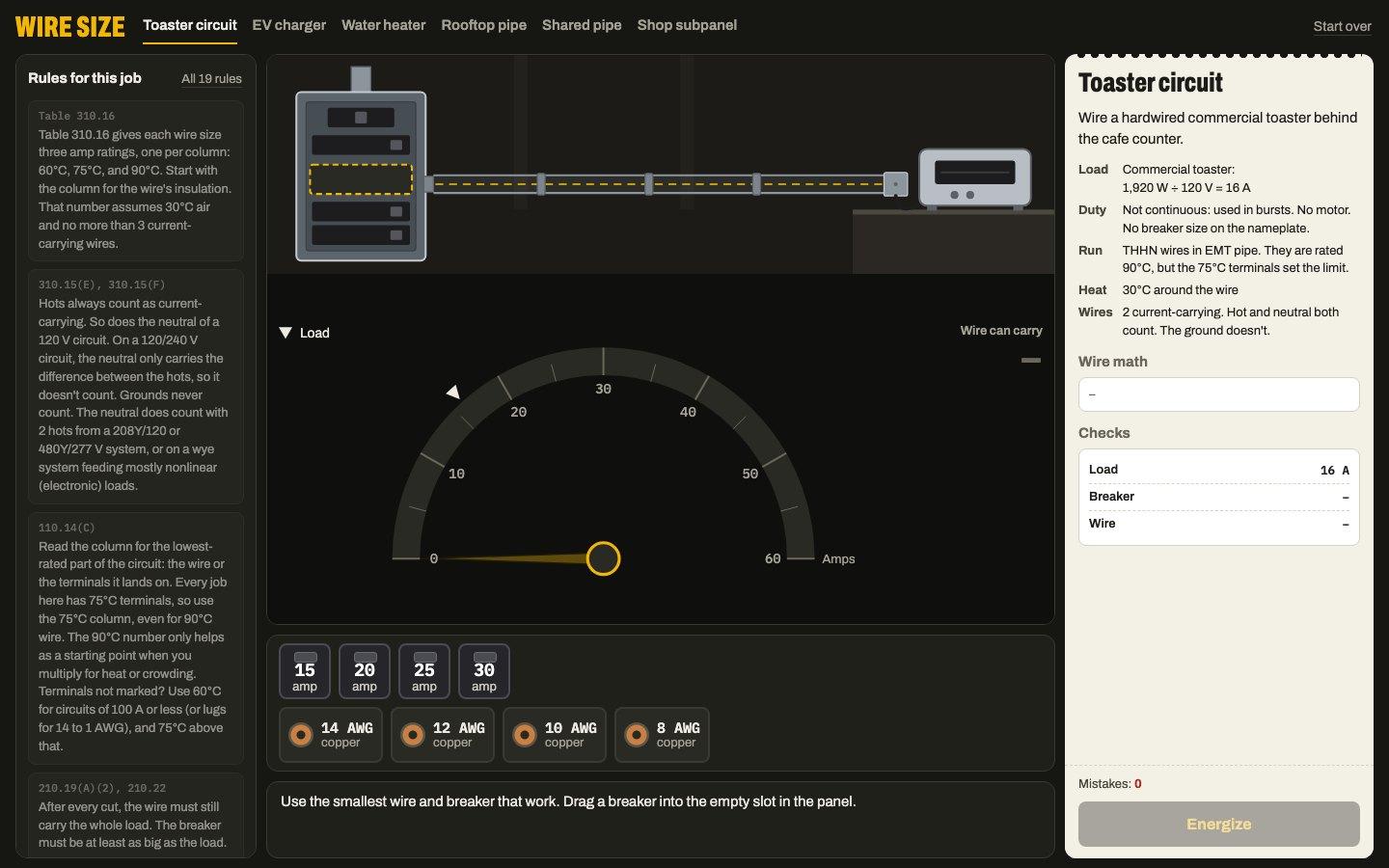
In Wire Size, you pick the breaker and wire for six loads, from a cafe toaster to a shop subpanel. A gauge shows the wire's ampacity from Table 310.16, then cuts it for heat, crowding, and terminal limits. It builds the skill of sizing a circuit for continuous loads under 210.19, 210.20, and 240.4.
- Continuous loads at 125%
- Heat and crowding factors
- Terminal temperature limits
- Small-wire breaker limits
How it works
Each job gives you a load, its nameplate, and the run. Drag a breaker into the panel and a wire spool onto the run. A gauge shows the wire's starting ampacity, then each cut for heat, crowding, and terminal or cable limits. On a phone, tap a breaker or wire spool to pick it up, then tap the panel or the wire run to put it in.
Read the gauge, then energize. A wrong pick trips the breaker, overheats the wire, or gets tagged by the inspector. You earn up to three stars: one for passing, one for no mistakes, and one for the smallest wire and breaker that work on your first spool. The simulation runs in a browser on a phone, tablet, or computer, with no sign-up.
The jobs
- 1Toaster circuit. Size a hardwired toaster, and see why 14 AWG copper stops at a 15 A breaker.
- 2EV charger. Size a 32 A EV charger as a continuous load: a 40 A breaker on 8 AWG copper.
- 3Water heater. Size a water heater on NM-B cable, which is held to the 60°C column.
- 4Rooftop pipe. Add 33°C for pipe in the sun close to a roof, and watch the heat factor cut 10 AWG to half.
- 5Shared pipe. Put 12 current-carrying wires in one pipe, and apply the 50% crowding factor.
- 6Shop subpanel. Size a continuous-load feeder in copper or aluminum, and round up to the next breaker size.
NEC 2026 sections it checks
- Table 310.16
- Gives each wire size an ampacity in the 60°C, 75°C, and 90°C columns.
- 310.15(B)(1)
- Correct the ampacity when the air around the wire isn't 30°C.
- 310.15(C)(1)
- Cut the ampacity when more than 3 current-carrying wires run together.
- 110.14(C)
- Use the column for the lowest-rated part: the wire or the terminals it lands on.
- 210.19(A)(1)
- The wire must handle 125% of a continuous load, plus the rest of the load.
- 210.20(A)
- The breaker must be at least 125% of a continuous load, plus the rest of the load.
- 240.4(D)
- Small copper wire has breaker limits: 15 A for 14 AWG, 20 A for 12 AWG, 30 A for 10 AWG.
- 240.4(B)
- When the wire falls between breaker sizes, you may round up to the next size, with limits.
Section numbers only. Read the full text in your code book.
2023 to 2026: our list has 4 changes in Article 310. See the changes
Questions apprentices ask
What size wire do you need for a 32 A EV charger?
An EV charger is a continuous load (625.41), so size for 125%: 32 A × 1.25 = 40 A. You need a 40 A breaker and wire rated 40 A or more in the 75°C column. 10 AWG copper is only 35 A there, so use 8 AWG copper, which is 50 A.
Why can't 14 AWG wire go on a 20 A breaker?
Table 310.16 shows 14 AWG copper at 20 A in the 75°C column, but 240.4(D) caps it at a 15 A breaker. The same rule caps 12 AWG copper at 20 A and 10 AWG copper at 30 A. The small-wire limit wins over the table.
What is the 125% rule for continuous loads?
A continuous load runs 3 hours or more. The wire and the breaker must both be rated for 125% of it, plus 100% of any other load (210.19(A)(1), 210.20(A)). Feeders follow the same rule (215.4(A), 215.5).
When do you derate for more than three wires in a pipe?
When more than 3 current-carrying wires run together for over 24 in., multiply by the factor in Table 310.15(C)(1): 80% for 4 to 6 wires, 70% for 7 to 9, and 50% for 10 to 20. Grounds never count. In the Crowded Pipe job, 12 wires at 50% drop 12 AWG to 15 A.
How this simulation was checked
Every rule the inspector applies was checked against the 2026 NEC text in a code review, and the game was play-tested for ease of use. It is a study aid. It doesn’t replace the code book, your instructor, or your local inspector.
See something wrong? Tell us and we will check it against the code.
I’m building these with instructors. What would you change? Tell Matt what is wrong or missing.
Teach it in one class
This simulation is part of a free lesson that plays in your browser, with a class plan and quiz questions: Wire sizing (NEC 2026 310.16, 240.4, 110.14(C), 210.19(A)).
Teaching a class?
Build a cited slide deck and quiz on any part of the 2026 NEC, in your own order, and assign this simulation as practice. Free for instructors during the pilot.
Check your work with a calculator
- Ampacity deratingApply ambient temperature and bundling adjustments to a conductor.
- Ground wire (EGC) sizeMinimum equipment grounding conductor from the breaker or fuse size.
More simulations
- Box FillClick what counts inside the box, pick the smallest box that holds it, and close the cover.
- Conduit FillDrop wires into a pipe drawn to scale, and pick the smallest pipe that stays under the fill limit.
- Load CalculationDrag floor area, circuits, and appliances onto a load calculation, and then size the service.