Box fill simulation
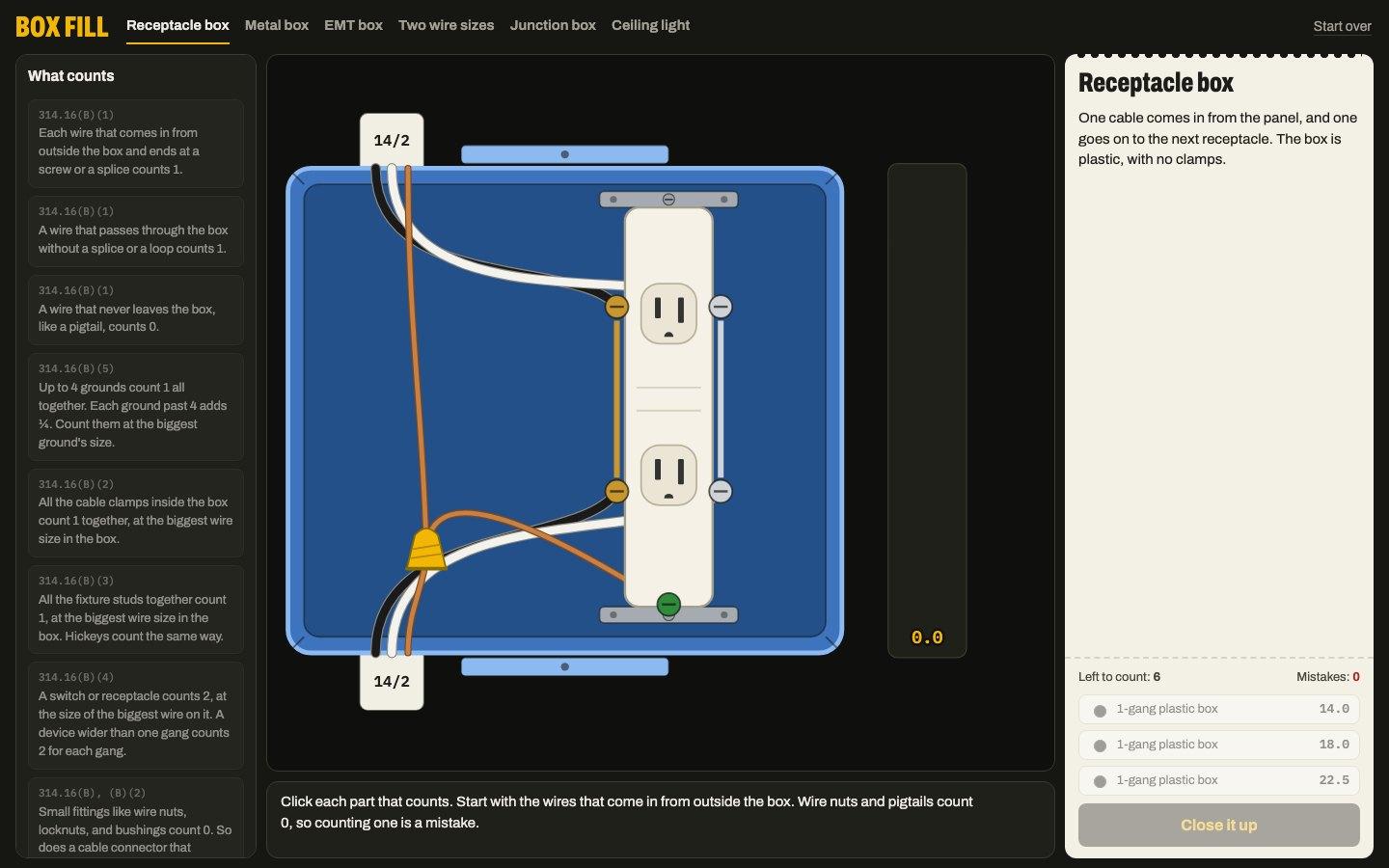
In Box Fill, you click each part inside an electrical box that counts toward fill, and then you pick the smallest box that holds it all. A meter adds up the volume under 314.16 as you go. It builds the skill of counting wires, grounds, devices, and clamps the way the code does.
- How wires, grounds, and devices count
- Clamps, fixture studs, and wires passing through
- Box sizes from the table
- Mixed wire sizes
How it works
Each job shows the inside of a box. Click each part that counts, and the meter fills with its volume. On a phone, tap a part to see its name, then tap it again to count it. Parts like wire nuts, locknuts, pigtails, and the box's ground screw count zero, and clicking one costs a mistake. Point at any part to see its name.
When the count is done, pick the smallest box on the shelf that holds it, and close the cover. You earn up to three stars: one for closing a legal box, one for no mistakes, and one for picking the smallest box on the first try. The simulation runs in a browser on a phone, tablet, or computer, with no sign-up.
The jobs
- 1Receptacle box. Count a receptacle box: each wire from outside counts 1, the grounds count 1 together, and the device counts 2.
- 2Metal box. Add built-in cable clamps, which count 1 together, with every count at the 12 AWG size.
- 3EMT box. Count a wire that passes straight through, and learn why locknuts and EMT connectors count 0.
- 4Two wire sizes. Count each wire at its own size, and size the clamps, the device, and the grounds by the right wire.
- 5Junction box. Count six grounds: the first 4 count 1 together, and each one past 4 adds ¼.
- 6Ceiling light. Count a fixture stud, and leave out the small wires that come down from the light's canopy.
NEC 2026 sections it checks
- 314.16(A)
- A box holds the volume in its table or marked on it, plus any ring or raised cover.
- 314.16(B)(1)
- Each wire that enters and ends in the box counts once. A pigtail that never leaves the box counts zero.
- 314.16(B)(2)
- All the internal cable clamps together count once, at the biggest wire in the box.
- 314.16(B)(3)
- Fixture studs count once, at the biggest wire in the box.
- 314.16(B)(4)
- Each device yoke counts twice, at the biggest wire landed on it.
- 314.16(B)(5)
- Up to four grounds count once together. Each extra ground adds a quarter.
- Table 314.16(B)(4)
- Each count takes 2.00 in³ for 14 AWG, 2.25 in³ for 12 AWG, and 2.50 in³ for 10 AWG.
Section numbers only. Read the full text in your code book.
2023 to 2026: our list has 5 changes in Article 314. See the changes
Questions apprentices ask
How many wires can go in a 4 × 1½ square box?
A 4 × 1½ in. square metal box holds 21.0 in³ (Table 314.16(A)). At 2.00 in³ per count for 14 AWG, that's room for 10 counts. At 2.25 in³ per count for 12 AWG, it's 9. A device counts 2, the grounds count 1, and clamps count 1, so count everything before you pick the box.
Do ground wires count in box fill?
Yes. Up to four grounds count 1 together, at the size of the biggest ground (314.16(B)(5)). Each ground past four adds ¼, so six grounds count 1½.
How much does a receptacle or switch count in box fill?
Each device yoke counts 2, at the size of the biggest wire landed on it (314.16(B)(4)). A device wider than one 2 in. gang counts 2 for each gang.
Do wire nuts and pigtails count in box fill?
No. Wire nuts, locknuts, and bushings count 0, and so does a cable connector that clamps outside the box (314.16(B)). A pigtail never leaves the box, so it counts 0 too (314.16(B)(1)).
How this simulation was checked
Every rule the inspector applies was checked against the 2026 NEC text in a code review, and the game was play-tested for ease of use. It is a study aid. It doesn’t replace the code book, your instructor, or your local inspector.
See something wrong? Tell us and we will check it against the code.
I’m building these with instructors. What would you change? Tell Matt what is wrong or missing.
Teach it in one class
This simulation is part of a free lesson that plays in your browser, with a class plan and quiz questions: Box fill (NEC 2026 314.16).
Teaching a class?
Build a cited slide deck and quiz on any part of the 2026 NEC, in your own order, and assign this simulation as practice. Free for instructors during the pilot.
Check your work with a calculator
More simulations
- Wire SizePick the breaker and wire for each load while a gauge shows how heat and crowding cut ampacity.
- Conduit FillDrop wires into a pipe drawn to scale, and pick the smallest pipe that stays under the fill limit.
- Load CalculationDrag floor area, circuits, and appliances onto a load calculation, and then size the service.