Dwelling load calculation simulation
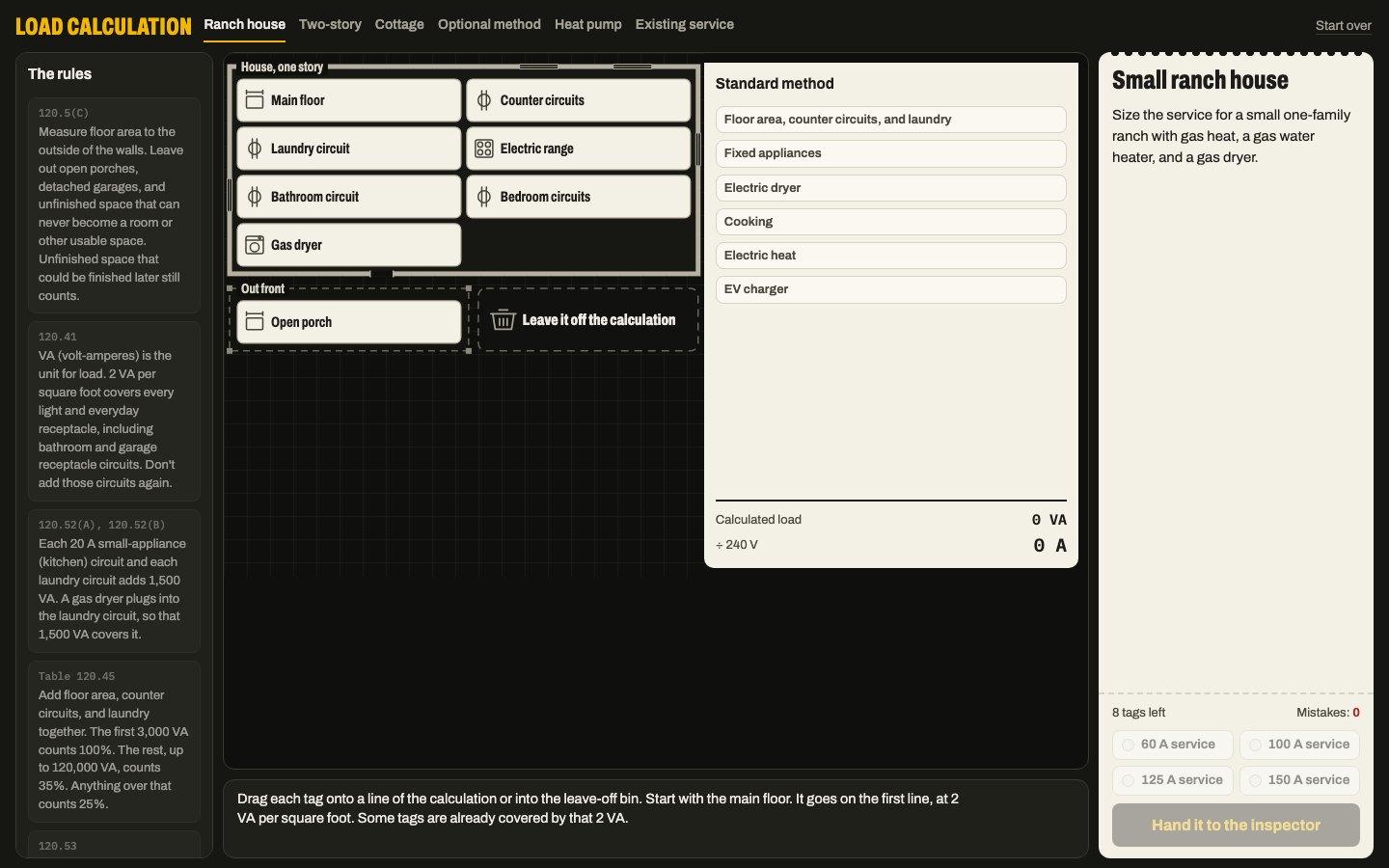
In Load Calculation, you drag floor area, circuits, and appliances onto a dwelling load calculation, and demand factors cut each line down. Then you size the service, or check whether an old service has room for an EV charger. It builds the skill of working the standard and optional methods in Article 120 of the 2026 NEC.
- What counts as floor area
- Demand factors line by line
- The optional method
- Adding an EV charger
How it works
Each job gives you a house and a stack of tags for floor area, circuits, and appliances. Drag each tag onto a line of the calculation, or into the leave-off bin, and the line applies its demand factor. On a phone, tap a tag to pick it up, then tap a line or the bin.
Then pick the smallest service that carries the load, or the biggest charger that fits, and hand it to the inspector. You earn up to three stars: one for passing, one for no wrong drops, and one for the right pick on the first try. The simulation runs in a browser on a phone, tablet, or computer, with no sign-up.
The jobs
- 1Small ranch house. Work a standard calculation for a small gas-heat house, and see that a one-family service is never under 100 A.
- 2All-electric two-story. Count four or more fixed appliances at 75%, and keep cooking equipment, dryers, and heat out of that group.
- 3Cottage with a basement. Count unfinished space that could become rooms, three fixed appliances at 100%, and a charger with no nameplate at 7,200 VA.
- 4Optional method. Add every appliance at nameplate, count 40% past the first 8,000 VA, and keep only the biggest heat or A/C load.
- 5Heat pump and EV charger. Count a heat pump at 100% with its backup strips at 65%, and an EV charger in full.
- 6Charger on an existing service. Use Table 120.83 to check whether an old 100 A service has room for an EV charger.
NEC 2026 sections it checks
- 120.5(C)
- Measure floor area to the outside of the walls, and leave out open porches and detached garages.
- 120.41
- Count 2 VA per square foot for lighting and everyday receptacles.
- 120.52(A), (B)
- Add 1,500 VA for each small-appliance circuit and each laundry circuit.
- Table 120.45
- Count the first 3,000 VA at 100%, the rest up to 120,000 VA at 35%, and anything over that at 25%.
- 120.53
- Four or more fixed appliances may count 75%. Three or fewer count 100%.
- 120.57
- An EV charger counts its nameplate, or 7,200 VA with no nameplate yet.
- 120.82
- The optional method counts the first 8,000 VA at 100% and the rest at 40%.
- 120.83
- Checks whether an existing service has room for new load.
Section numbers only. Read the full text in your code book.
2023 to 2026: our list has 15 changes in Article 120, which was Article 220 in 2023. See the changes
Questions apprentices ask
What is the minimum service size for a house?
A one-family house never gets less than a 100 A service, even when the calculation comes out lower (230.79(C)). The service must also carry at least the calculated load. To get amps, divide the total VA by 240 V (120.5(A), (B)).
How do you count an EV charger in a load calculation?
In the standard method, an EV charger counts its nameplate, or 7,200 VA if there's no nameplate yet (120.57). In the optional method, chargers stay off the general line, so they count 100% instead of 40% (120.82(D)). For an existing service, Table 120.83 counts a new charger at 80%.
When can fixed appliances count at 75%?
Four or more fixed appliances, each 500 W or ¼ hp and up, may count 75% (120.53). Three or fewer count 100%. Built-in cooking equipment, dryers, heat, A/C, and EV charger loads never join this group.
What does the optional method change?
The optional method in 120.82 adds floor area, circuits, and every appliance at nameplate, range and dryer included. The first 8,000 VA counts 100%, and the rest counts 40%. For heat and A/C, only the biggest choice counts (120.82(C)).
How this simulation was checked
Every rule the inspector applies was checked against the 2026 NEC text in a code review, and the game was play-tested for ease of use. It is a study aid. It doesn’t replace the code book, your instructor, or your local inspector.
See something wrong? Tell us and we will check it against the code.
I’m building these with instructors. What would you change? Tell Matt what is wrong or missing.
Teach it in one class
This simulation is part of a free lesson that plays in your browser, with a class plan and quiz questions: Dwelling load calculation (NEC 2026 Article 120).
Teaching a class?
Build a cited slide deck and quiz on any part of the 2026 NEC, in your own order, and assign this simulation as practice. Free for instructors during the pilot.
Check your work with a calculator
More simulations
- Box FillClick what counts inside the box, pick the smallest box that holds it, and close the cover.
- Wire SizePick the breaker and wire for each load while a gauge shows how heat and crowding cut ampacity.
- Conduit FillDrop wires into a pipe drawn to scale, and pick the smallest pipe that stays under the fill limit.