Conductors and insulators
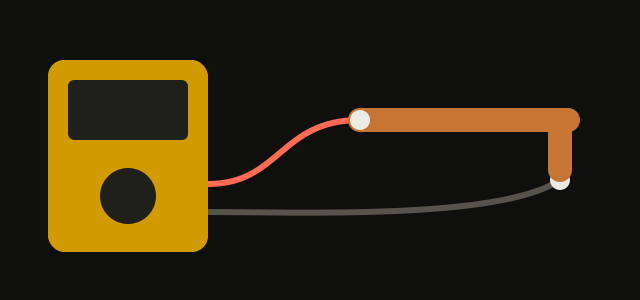
Some materials let current through easily and some almost stop it. You measure copper, aluminum, rubber, and skin with a meter, then change the wire's length, thickness, and heat.
Open the visualFree, no sign-up. Works on a phone, tablet, computer, or projector.
What to try
- 1Start on Copper, then pick Rubber. Rubber is an insulator, so the meter reads OL.
- 2Pick Dry skin, then Wet skin. Wet skin has far less resistance, so it lets much more current through.
- 3Pick Copper and set Length to 1,000 ft. Twice the length gives twice the resistance. Then set Thickness to 8 AWG and watch it fall.
NEC 2026 sections it covers
- 310.5(A)
- The smallest aluminum wire size is 12 AWG.
Section numbers only. Read the full text in your code book. Temperatures and times in the visual are teaching models.
See something wrong? Tell us and we will check it against the code.
More visuals
- A circuit is a loopCurrent flows only when it has a full path out and back. Open the switch or break a wire and watch it stop.
- Volts, amps, and ohmsChange the voltage or the heater and watch the amps follow. Amps equal volts divided by ohms.
- Why you get shockedA shock happens when your body joins two points at different voltages. See why a breaker never notices it and a GFCI does.