Why voltage drops
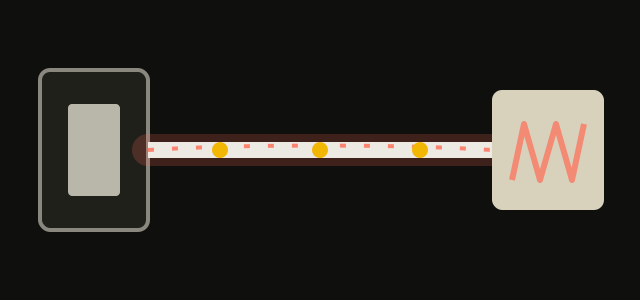
Every foot of wire has a little resistance, so the wire acts like a small resistor in series with the heater. You change the length, the wire size, and the load and watch the volts lost on the way.
Open the visualFree, no sign-up. Works on a phone, tablet, computer, or projector.
What to try
- 1Start on 25 ft with the 1,000 W heater. The heater gets nearly the full 120 volts.
- 2Set Length to 200 ft. The wire now loses far more voltage and turns it into heat.
- 3Keep 200 ft and set Wire size to 10 AWG. Thicker wire has less resistance, so the heater gets more of the voltage.
NEC 2026 sections it covers
- 210.19
- An informational note suggests losing no more than 3% on a branch circuit.
- 215.4(A)(2)
- With the feeder counted too, the target is 5%.
- 90.5(C)
- Informational notes are advice, not rules.
- 240.4(D)
- 14 AWG copper gets a 15 A breaker at most.
- 250.122(D)
- When the hots are made bigger for voltage drop, the ground gets bigger too.
- 424.19(B)(1)
- A breaker that is the heater's shutoff must lock off when it is out of sight.
- 110.29
- In sight means you can see it and it is 50 ft away or less.
- 210.12(B)
- Many rooms in a home also need AFCI protection.
Section numbers only. Read the full text in your code book. Temperatures and times in the visual are teaching models.
See something wrong? Tell us and we will check it against the code.
Practice it and teach it
- Voltage Drop simulationStretch a run across the yard and watch the lamp dim, then size the wire to keep the drop in spec.
- Voltage drop lessonVoltage drop (NEC 2026 informational notes and Chapter 9, Table 8)
More visuals
- A circuit is a loopCurrent flows only when it has a full path out and back. Open the switch or break a wire and watch it stop.
- Conductors and insulatorsPut copper, aluminum, rubber, or skin on the meter and see how hard each one makes it for current to get through.
- Volts, amps, and ohmsChange the voltage or the heater and watch the amps follow. Amps equal volts divided by ohms.