Voltage drop simulation
In Voltage Drop, you run circuits and feeders across a yard and watch the lamp dim as the run gets longer. You dig trenches, pick wire using Chapter 9, Table 8, and keep the drop inside the job spec. It builds the skill of working voltage drop by hand and knowing which limits are advice and which are code.
- Length, wire size, and voltage
- Copper versus aluminum
- Feeder plus branch drop
- The 3% and 5% advice, and who enforces it
How it works
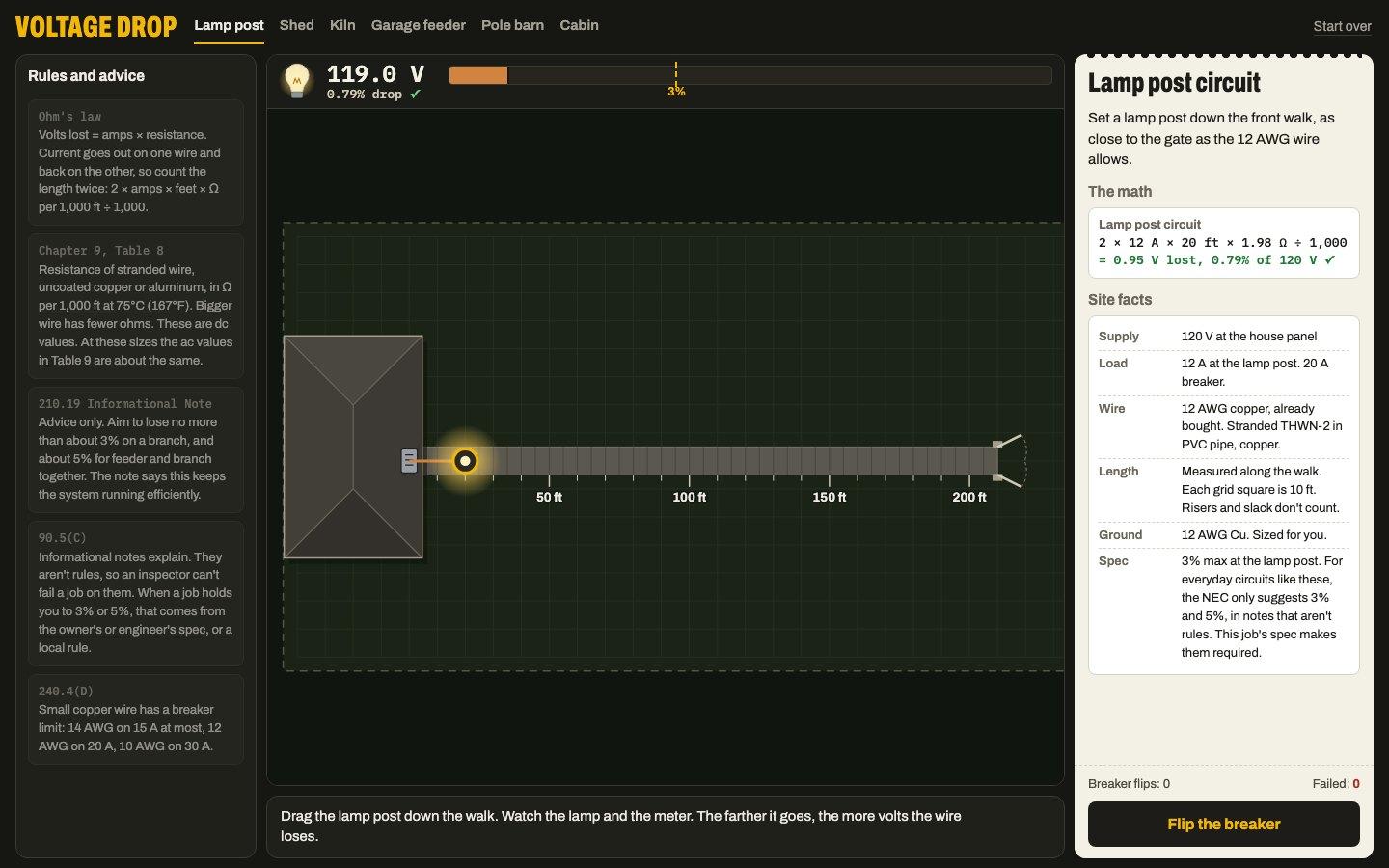
In the first job, you drag a lamp post down the walk and watch the lamp and the meter as the volts drop. In later jobs, you drag from a yellow + to dig a trench, then click a reel to pull wire. Each reel shows its resistance from Table 8. Some jobs also let you choose 120 V or 240 V, or copper or aluminum. On a phone, slide the lamp post with your finger. To dig, tap the yellow + and then tap the yard, and tap a reel to pull wire.
Turn on the power to test the run against the job spec and the code rules. You earn up to three stars: one for meeting the spec, one for passing on the first try, and one for using the least metal. The simulation runs in a browser on a phone, tablet, or computer, with no sign-up.
The jobs
- 1Lamp post circuit. Slide a lamp post down the walk, and see that twice the distance loses twice the volts.
- 2Shed circuit. Run a circuit around the pool, and pick a bigger wire using its Table 8 resistance.
- 3Kiln circuit. Feed a kiln at 120 V or 240 V, and see why 240 V cuts the percent drop to a quarter.
- 4Garage feeder. Size a feeder in copper or aluminum, and see why aluminum needs a bigger size than copper.
- 5Pole barn feeder and branch. Split the drop between a feeder and a branch so the far outlet stays under 5% in total.
- 6Cabin feeder and branch. Plan the whole path, with short trenches and the right feeder and branch split, to use the least metal.
NEC 2026 sections it checks
- Chapter 9, Table 8
- The resistance of copper and aluminum wire, in ohms per 1,000 ft.
- 210.19 Informational Note
- Advises about 3% drop on a branch circuit and 5% in total. It's advice, not a rule.
- 215.4(A)(2) Informational Note No. 2
- Gives the same 3% and 5% advice for feeders.
- 90.5(C)
- Informational notes explain the code. An inspector can't fail a job on them.
- 240.4(D)
- Small copper wire has breaker limits: 15 A for 14 AWG, 20 A for 12 AWG, 30 A for 10 AWG.
- 240.4, Table 310.16
- The breaker must protect the wire, read from the 75°C column.
- 250.122(D)
- Make the hots bigger for voltage drop, and the ground grows by the same ratio.
Section numbers only. Read the full text in your code book.
2023 to 2026: our list has 3 changes in Article 215. See the changes
Questions apprentices ask
How do you calculate voltage drop?
Volts lost equal amps times resistance. Current goes out on one wire and back on the other, so count the length twice: 2 × amps × feet × ohms per 1,000 ft ÷ 1,000. Read the ohms from Chapter 9, Table 8. For 12 AWG copper, Table 8 gives 1.98 ohms per 1,000 ft.
Does the NEC require 3% voltage drop?
No. The 3% and 5% figures come from informational notes in 210.19 and 215.4(A)(2), and 90.5(C) says those notes aren't rules. An inspector can't fail a job on them. When a job holds you to 3% or 5%, that comes from the owner's or engineer's spec, or a local rule.
Does aluminum wire have more voltage drop than copper?
Yes. Aluminum has about 1.6 times the resistance of copper, as Chapter 9, Table 8 shows. For about the same drop, go one standard size up: 8 AWG aluminum is close to 10 AWG copper. The Garage Feeder job lets you compare the two on the same run.
If you upsize wire for voltage drop, do you upsize the ground?
Yes. When you make the hots bigger for voltage drop, the ground must grow by the same ratio of circular mils (250.122(D)). Circular mils measure the metal's cross-section. The simulation sizes the ground for you, so you can focus on the hots.
How this simulation was checked
Every rule the inspector applies was checked against the 2026 NEC text in a code review, and the game was play-tested for ease of use. It is a study aid. It doesn’t replace the code book, your instructor, or your local inspector.
See something wrong? Tell us and we will check it against the code.
I’m building these with instructors. What would you change? Tell Matt what is wrong or missing.
Teach it in one class
This simulation is part of a free lesson that plays in your browser, with a class plan and quiz questions: Voltage drop (NEC 2026 informational notes and Chapter 9, Table 8).
Teaching a class?
Build a cited slide deck and quiz on any part of the 2026 NEC, in your own order, and assign this simulation as practice. Free for instructors during the pilot.
Check your work with a calculator
More simulations
- Box FillClick what counts inside the box, pick the smallest box that holds it, and close the cover.
- Wire SizePick the breaker and wire for each load while a gauge shows how heat and crowding cut ampacity.
- Conduit FillDrop wires into a pipe drawn to scale, and pick the smallest pipe that stays under the fill limit.