Bonding at a transformer
A 480 volt feeder runs to a transformer that makes a new 208 and 120 volt system. The code calls it a separately derived system, so its neutral gets its own bond. You take the bonding jumper out, bond it twice, and put a fault on the heater.
Open the visualFree, no sign-up. Works on a phone, tablet, computer, or projector.
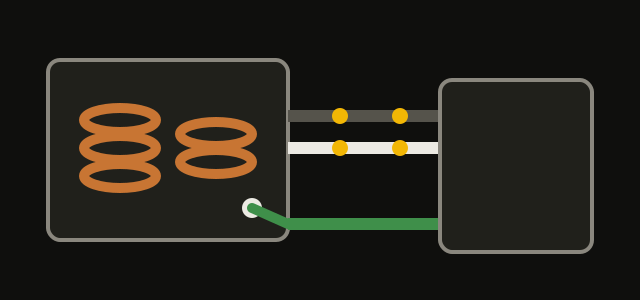
What to try
- 1On Bonded right, set Fault to Hot touches case. Hundreds of amps rush back on the ground wires, and the breaker trips at once.
- 2Pick No bonding jumper and set Fault to Hot touches case. The fault current has no way back, so the breaker stays on.
- 3Pick Bonded twice. Part of the heater's current flows on the supply-side bonding jumper all the time.
NEC 2026 sections it covers
- 250.30(A)
- The new system gets its own bond between neutral and ground.
- 250.30(A)(1)
- The system bonding jumper goes at the transformer or the first disconnect, in one place only.
- 250.4(A)(5)
- Fault current needs a low-resistance path back to the source.
- 250.30(A)(2)
- A supply-side bonding jumper runs from the transformer case to the panel.
- 250.30(A)(5)
- The grounding electrode conductor ties the new system to an electrode.
- 250.30(A)(4)
- The transformer uses the building's grounding electrode system.
- 250.68(C)
- Building steel can be part of the path to the electrode.
- 250.142(B)
- Past the bond, the neutral must not connect to ground wires or metal parts.
- 250.6(A)
- Grounding must not put normal current on ground wires.
- Table 310.16
- The table of allowed amps for each wire size.
- Table 250.102(C)(1)
- It sizes the bonding jumpers from the size of the hots.
- Table 250.66
- It sizes the grounding electrode conductor.
- Table 250.122
- It sizes each ground wire from its breaker.
- Table 450.5(B)
- It limits the transformer's breaker to a percentage of its rated current.
- 240.4(D)
- 12 AWG copper gets a 20 A breaker at most.
- 424.5
- A fixed electric heater counts as a continuous load.
Section numbers only. Read the full text in your code book. Temperatures and times in the visual are teaching models.
See something wrong? Tell us and we will check it against the code.
More visuals
- 120 and 240 voltsOne coil on the pole makes two legs that mirror each other. Put a meter across any two wires.
- Switch the hotWires are colored by voltage. See why a light can be off and still live.
- From the pole to the panelThe transformer on the pole sends two hots and a neutral to the house. Break the neutral and watch the voltages split.